Thursday, March 29, 2012

More than a religious action....


More than a religious action.... 

16 “This is the covenant I will make with them after that time, says the Lord. I will put my laws in their hearts, and I will write them on their minds.” (*quoting Jeremiah 31:33) 17 Then he adds: “Their sins and lawless acts I will remember no more.” (*quoting Jeremiah 31:34) 18 And where these have been forgiven, sacrifice for sin is no longer necessary.” -Hebrews 10:16-17 NIV
The primary purpose of the Letter to the Hebrews is to exhort Christians to persevere in the face of persecution. The central thought of the entire Epistle is the doctrine of the Person of Christ and his role as mediator between God and humanity.  No author is internally named. Since the earliest days of the Church, the authorship has been debated. In the 4th century, Jerome and Augustine of Hippo supported: the Church largely agreed to include Hebrews as the fourteenth letter of Paul, and affirmed this authorship until the Reformation. However, many scholars now believe that the author was one of Paul's pupils or associates, citing stylistic differences between Hebrews and the other Pauline epistles.  The epistle opens with an exaltation of Jesus as "the radiance of God's glory, the express image of his being, and upholding all things by his powerful word."[ The epistle presents Jesus with the titles "pioneer" or "forerunner," "Son" and "Son of God," "priest" and "high priest." It has been described as an "intricate" New Testament book. The epistle casts Jesus as both exalted Son and high priest, a unique dual Christology.

As I re-read Hebrews 10:16-17, the authors grammatical tense and selection of Old Testament quotations captured my attention.
Let’s go vs 16, “This is the covenant I will make with them after that time...”  From this statement I can conclude that the author is about to roll out a “new” covenant that will be established “after that time...” 

First things first. 

In order to answer the question, “after what time?” I need to read the entire text the author is referencing.  

Let’s go Jeremiah 31:1-33.  In this section of text, I found Jeremiah discussing: 

A. God’s sovereignty. 

B. God’s desire for all people to know and be in a genuine growing relationship with Him. 

C. God’s faithfulness to respond (this is often outside my timeline)

D. Obedience to the Old Testament law. 

E. Discipline. 

F. A promise to bring the people back from captivity. (When? Unknown.)

Wow, this sounds a bit like a few sections of my life’s story! 
Respectable guidance from my dad, a close mentor, an old friend, and what do I do.... not listen / do what I want!  What are the results of not listening?  Discovering things through consequences / discipline.
Let’s jump back into Hebrews 10:16-17,
“I will put my laws in their hearts, and I will write them on their minds.” (*quoting Jeremiah 31:33) 17 Then he adds: “Their sins and lawless acts I will remember no more.” (*quoting Jeremiah 31:34) 18 And where these have been forgiven, sacrifice for sin is no longer necessary.” -Hebrews 10:16-17 NIV
Now that sounds like Good News in the midst of everyday life!  
  • God will put HIs laws in my heart, and He will write them on my mind.
  • My sin and lawless acts (sin/lawless act = that violates a known moral rule in a religion. The term sin may also refer to the state of having committed such a violation. Sin can refer not only to physical actions taken, but also to thoughts and internalized motivations and feelings. Colloquially, any thought, word, or act considered immoralselfishshameful, harmful, or alienating might be termed "sinful".) God will remember no more!  
    • Why? look at verse 18
  • And where I have been forgiven (my sin and lawless acts)sacrifice (Sacrifice is the offering of food, objects or the lives of animals or people to God or the gods as an act of propitiation or worshipis no longer necessary.
    • A.K.A.: God is the ultimate / final judge of every individual.  He states, I’m forgiving and sacrifice is no longer necessary.  
Four questions come to mind, 
A) Why should I desire to be ‘forgiven?’ 

B) What does it mean to be ‘forgiven’ by God? The concepts of ‘forgiveness’ suggest that I have an offense with God - hmm.... 

C) How does God issue ‘forgiveness?’ 

D) How does God’s ‘forgiveness’ play out for those prior / after the establishment of the ‘new’ covenant? A.K.A. How does it play out for me?
Okay, I can go on and on today; however, my time is limited.

If I’m really about developing a relationship God verses merely being apart of some religious movement / organization. A vital aspect to my relationship with God - as well as to my understanding of God - to wrestle with these and other questions via my interactions with Him via reading the Bible.
- Reading alone is like asking my wife to go see a movie and then never interacting about it -(lol)- if I’m wise I’m not going down that road.  
  • Observing, reading, and questioning / interacting (via writing out my thoughts, questions, and interaction with the text via observations / applications) moves this from a practical / logical routine into a relational aspect.
This is really “good news” / something I would share!  

Monday, March 19, 2012

Evaluations.... Really God? Why? For what purpose?


Evaluations.... Really God?  Why?  For what purpose? 
SCRIPTURE 
it matters very little how I might be evaluated by you or by any human authority. I don’t even trust my own judgment on this point. 4 My conscience is clear, but that doesn’t prove I’m right. It is the Lord himself who will examine me and decide. 7 For what gives you the right to make such a judgment? What do you have that God hasn’t given you? And if everything you have is from God, why boast as though it were not a gift?.” - 1 Corinthians 4:3-4 & 7 (NLT)
OBSERVATION 
Okay God, let’s do this!  Two key points that seemed to leap off the page and grab both my heart and mind this morning: 1st: The concept of evaluation: self / others (vs 3-4).  2nd: Bottom line self-evaluation questions laid out in verse 7. 
First a question: How does our culture define this concept of evaluation?  Wikipedia states, “Evaluation is the comparison of actual impacts against strategic plans. It looks at original objectives, at what was accomplished and how it was accomplished. It can be formative, that is taking place during the life of a project or organization, with the intention of improving the strategy or way of functioning of the project or organization. It can also be summative, drawing lessons from a completed project or an organization that is no longer functioning. Not all evaluations serve the same purpose some evaluations serve a monitoring function rather than focusing solely on measurable program outcomes or evaluation findings and a full list of types of evaluations would be difficult to compile.  This is because evaluation is not part of a unified theoretical framework,drawing on a number of disciplines, which include management and organizational theory, policy analysiseducationsociologysocial anthropology, and social change.  Evaluation is inherently a theoretically informed approach (whether explicitly or not), and consequently a definition of evaluation would have be tailored to the theory, approach, needs, purpose and methodology of the evaluation itself.”
Let’s take things back to the text and gain some perspective on 1 Corinthians 4.  The book was written from Ephesus (16:8), a city on the west coast of today's Turkey, about 180 miles by sea from Corinth. According to Acts of the Apostles, Paul founded the church in Corinth (Acts 18:1-17), then spent approximately three years in Ephesus (Acts 19:8, 19:10, 20:31). The letter was written during this time in Ephesus, which is usually dated as being in the range of 53 to 57 AD.  Okay, how does Paul define this concept of evaluation?  In verses 3-4 Paul makes notes of his ‘opinion’ and reveals that weight this concepts holds in saying, ‘It is a very small things that I may be examined.‘  Paul continues to express his thoughts about, questioning, examining, interrogating the use of judicial examination of self and others before the final verdict is given by God (see vs 4); and then, in verse 4 he attaches evaluation to a concept of justification.  What does justification mean?  According to vs 4 to justify, is to declare to be in the right stance, posture, heart, mindset, or in the right standing.  Paul seems to communicate that he spends very little time examining himself and leaves this examination to “the Lord” (v4).  It’s seems like Paul is contradicting himself as he is also known as one who continually presses forward.... ....and in order press forward effectively ‘I’ must evaluate things - right? 
Let’s go Philippians 3:8-15 (NLT), 8 Yes, everything else is worthless when compared with the infinite value of knowing Christ Jesus my Lord. For his sake I have discarded everything else, counting it all as garbage, so that I could gain Christ 9 and become one with him. I no longer count on my own righteousness through obeying the law; rather, I become righteous through faith in Christ.  For God’s way of making us right with himself depends on faith. 10 I want to know Christ and experience the mighty power that raised him from the dead. I want to suffer with him, sharing in his death, 11 so that one way or another I will experience the resurrection from the dead! 12 I don’t mean to say that I have already achieved these things or that I have already reached perfection. But I press on to possess that perfection for which Christ Jesus first possessed me. 13 No, dear brothers and sisters, I have not achieved it, but I focus on this one thing: Forgetting the past and looking forward to what lies ahead, 14 I press on to reach the end of the race and receive the heavenly prize for which God, through Christ Jesus, is calling us.”
As I re-read both 1 Corinthians 4 and Philippians 3 my confusion is clarified.  It appears that Paul does spend a lot of time evaluating his past but places his energy on the future application - AKA: What’s ahead of him.  
Okay, God what are YOU saying to me this morning? ..... ..... Is my evaluation for applause, accolades, or for future progression?  What is the purpose of my evaluation?  Self-improvement, others standards, or to please God?  If my aim is to please God, can I earn He approval?   How do i please Him?  How does this concept of daily play into my relationship with Christ?  Trust.... Obedience... Actions/Reactions.... 
APPLICATION =A:
Bottom line self-evaluation questions (vs 7), “7 For what gives you the right to make such a judgment? What do you have that God hasn’t given you? And if everything you have is from God, why boast as though it were not a gift?.
What gives me the right to make such a judgement on myself or others?  What do I have that God hasn’t given me?  What do I want that God has not given me and why do I really want it?  If everything I have is really from God, why do I boast at times as if it was not a provision and gift from Him?   
Okay... Who I am to NOT freely extend all that YOU have FREELY EXTEND to me?  ALL that I that YOU have given me!  Life & health!  How? Creator.  Provision!  How?  My paid check comes from my employer.  Where does my employer get the funds to pay me?  Individuals.  Where do those individuals receive their provision?  Wow... It’a all tracks back to YOU creating the concept of finances, employment, and ultimately me working (Genesis)!  What about the things I earned?  AKA: Awards, accomplishments, etc.?    Ultimately, YOU’ve created and placed those before me also!  What about the difficult times, the trails, the hardships?  .... .... Ya.... I can also see YOUR hand allowing those things to also touch my life.... .... 
Bottom line: Everything that touches my life both GREAT, GOOD, and not so good YOU - GOD have allowed to touch my life!  
PRAYER 
Help me take Paul’s mindset on and NOT exhaust myself via self evaluation but evaluate myself with forward progress in mind.  I like Paul have NOT “achieved it, but I focus on this one thing: Forgetting the past and looking forward to what lies ahead, I press on to reach the end of the race and receive the heavenly prize for which God, through Christ Jesus, is calling me.”  God, thank YOU for speaking to me through out the week - calling me to be with YOU!   Help me, “TRUST in YOU with all my heart and NOT lean on my own understanding. In all my ways HELP me acknowledge YOU, (TRUSTING) YOU will make your paths straight.” - Proverbs 3:5-6.  Ultimately, I see today that it’s not all that I do, achieve, or accomplish.... but that YOU really desire ME.... time with me; so that, we can have a relationship.... .... Here I am.... Thank YOUGod for meeting me here and caring so much about me that YOU don’t want me to get hung up over past issues.... .... and YOU deeply care about my future.... Wow, God.... it’s not about what I might accomplish for YOU but YOUR really focused on my complete health and truly desire to do life with me.... every step along the way!!!!  Thank YOU God, for caring so much and meeting me right where I am at.  I choose to start moving forward now via being with YOU and taking baby steps forward. - Trevor
youR thoughtS?
Blog's:

Tuesday, March 13, 2012

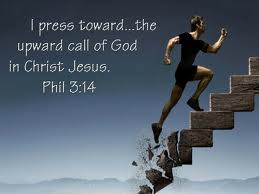
I press on.... for what?


I PRESS ON!
Endurance, perseverance, overcoming.... for WHAT?!!!? 

“I press on, that I may lay hold of that for which Christ Jesus has laid hold of me.” - Philippians 3:12 (NASB)
Let’s jump and go terminology and then ask a few questions“I press on, that I may lay hold of that for which Christ Jesus has laid hold of me.”  
Let’s go Philippians 3:1-11 (NIV) and establish some textual background: “1 Further, my brothers and sisters, rejoice in the Lord! It is no trouble for me to write the same things to you again, and it is a safeguard for you. 2 Watch out for those dogs, those evildoers, those mutilators of the flesh. 3 For it is we who are the circumcision, we who serve God by his Spirit, who boast in Christ Jesus, and who put no confidence in the flesh— 4 though I myself have reasons for such confidence. If someone else thinks they have reasons to put confidence in the flesh, I have more: 5 circumcised on the eighth day, of the people of Israel, of the tribe of Benjamin, a Hebrew of Hebrews; in regard to the law, a Pharisee; 6 as for zeal, persecuting the church; as for righteousness based on the law, faultless. 7 But whatever were gains to me I now consider loss for the sake of Christ. 8 What is more, I consider everything a loss because of the surpassing worth of knowing Christ Jesus my Lord, for whose sake I have lost all things. I consider them garbage, that I may gain Christ 9 and be found in him, not having a righteousness of my own that comes from the law, but that which is through faith in Christ—the righteousness that comes from God on the basis of faith. 10 I want to know Christ—yes, to know the power of his resurrection and participation in his sufferings, becoming like him in his death, 11 and so, somehow, attaining to the resurrection from the dead.”
Okay, here in chapter 3 we can clearly see that Paul is sending counsel regarding spiritual adversaries among the Philippians (3.1-21).  He then provides receipt of both Epaphroditus' heroism (3.25-30), along with his promise of a divine accounting (4.17-20).  
According to the text, what has Jesus “laid hold of”?  What is the author (Paul) attempting to “lay hold of”?
Hmmm... Is a portion of my answer found within this concept ‘confidence in the flesh’?  How would I define, ‘confidence in the flesh’? 
‘Confidence in the flesh’ is what happens, when I rest on past achievements. When what I’ve done at one time becomes our grounds of boasting: an experience I’ve gone through, that others didn't have . . . an award I’ve won . . . an honor I’ve had. To rest on past achievements represents confidence in the flesh.  Another perspective would saying that, ‘confidence in the flesh’ is what happens, when men claim they are good and right because of their connections: blood connections; who I know; who I’m associated with, or my title.... 
.... confidence is also something God wants us to have - so where is the balance?  
If God allows me experience victories, receive awards, and surround me with amazing individuals - adding depth to my personal confidence - is this not a great (GOD) thing?  Hmm.... Can I say, confidence solely stands on 'who I am, what I've done, etc...' will fail!  A 'confidence' that is bigger than myself... in God is more sustainable...    
Wow, this really does ties into my personal DNA and confidence.  Can I conclude that one area Jesus ‘laid hold of’ is was Paul’s confidence?  AKA: My desires to also laid hold of my confidence?  If that’s true then I can also conclude that as place my confidence in Him (aka. learn to trust Him) -  God will revile His design / created purpose for my life?  Hmm..... ..... How does my confidence daily roll out / transfer into my relationship with Christ? trust.... obedience... perception.... action/reaction.... faith.... 
APPLICATION =A:
A-First a personal question: 
“Where is my confidence founded?"
My family name, experiences I’ve gone through, accomplishments, honors, achievements, who I know.... .... my failures, shortcomings, countless mistakes I’ve made.... .... things I’ve persevered, my endurance.... .....  hmm.... each of these have shaped and formed me into who I am today - each victory, failure, 
A = I need to keep my mind, heart, and emotions connected to God.  Keeping in mind that I am not simply called to stroll through this life simply being a good person, but to preach the gospel at all times - and when necessary to use words.
Bottom line: I need to place my FULL confidence in God’s word / ways.
PRAYER 
God I’m reminded of Proverbs 3:5-6. “TRUST in YOU with all my heart and NOT lean on my own understandingIn all my ways HELP me acknowledge YOU, (TRUSTING) YOU will make your paths straight.”  I have to many lingering questions: ‘what if I don’t hear YOU correctly?’ ‘what if I fail and it impact my family deeply?’ etc... .... God, I do doubt and lingering questions.  Mark 9:24 states, "Immediately the boy’s father exclaimed, “I do believe; help me overcome my unbelief!” God help me overcome my unbelief- Trevor


youR thoughtS?

Blog's:

Monday, February 20, 2012

HOPE in the midst of CHAOS


HOPE in the midst of CHAOS 

“33 Until the day was about to dawn, Paul was encouraging them all to take some food, saying, “Today is the fourteenth day that you have been constantly watching and going without eating, having taken nothing. 34 Therefore I encourage you to take some food, for this is for your preservation, for not a hair from the head of any of you will perish.” 35 Having said this, he took bread and gave thanks to God in the presence of all, and he broke it and began to eat. 36 All of them were encouraged and they themselves also took food.” - Acts 27:33-36 (NASB)

Before I jump into the text let me make a brief recap of Acts 27 as I following the Apostle Paul's missionary journeys: 
A) Paul was arrested in Judea 
B) While being tried before a judge, Paul makes a personal appeal to have Caesar hear the case on the basis of his Roman citizenship. 
C) Paul’s request is granted and he is transported as a prisoner to Rome.  

Next, let’s take a look at things from the standpoint of historical evidence, the account found in the book of Acts recording Paul's voyage and shipwreck is supported by a wealth of detail. It’s here that history provides us with a striking meteorological and nautical confirmation of the biblical record.

Okay what about the accuracy of Luke sailing records? "Luke records that the ship drifted for fourteen days in the gale and then shipwrecked on the island of Malta, halfway across the Mediterranean. This account of a fourteen day gale, followed by a shipwreck on a remote island, reads like a tall tale! 
However, the meteorological and nautical evidence demonstrates, in rather spectacular fashion, that these events must have occurred just as Luke records them. The most important piece of evidence is the compass bearing of the gale. This bearing can be established by means of three separate calculations. 
First, Luke states that Euraquilo struck shortly after they left Fair Havens. In other words, the ship must have been less than halfway to their intended destination at Phoenix. This would put it somewhere between Cape Matala and a point seventeen miles W.N.W. of the Cape when the gale struck. 
Second, there is the relation of the island of Clauda (or Cauda) to this start point. Cape Matala is on a bearing of east 7 degrees north from the eastern edge of Clauda, while the halfway point to Phoenix is east 40 degrees north. For the ship to get behind Clauda, Euraquilo must have been blowing from a point somewhere between these two bearings. The point midway between these two figures is east 25 degrees north (or E.N.E. 1/4 N.). This cannot be more than a point and a half off the actual direction of the wind. 
Third, Luke states that when they got behind Clauda, the sailors were afraid that they would be blown onto the Syrtis sandbanks of the north Africa coast. However, for them to have been blown onto those banks from Clauda, Euraquilo would have had to have been blowing from a point somewhere between east 18 degrees north and east 37 degrees north. The point midway between these figures is east 27 degrees north. This figure is only 1/4 point off the mean figure of the previous calculation.  These three calculations establish that the direction from which the wind was blowing could not have been more than a point off the designation E.N.E. 1/2 N. This brings us to a another dramatic piece of evidence. As the ship drifted west from Clauda, it would have been pointed due north. We know this because it could not have been pointed directly into the wind without capsizing. In other words, it had to have been pointed just off the direction from which the wind was blowing. Using this information, we can calculate with some precision both the direction and rate of the ship’s drift to the west. Ancient records reveal that Egyptian grain ships were the largest vessels of the time, being about the size of an early nineteenth century sailing vessel. This size is implicitly confirmed by Luke’s statement that there were 276 people on board. Since their ship was pointed due north, while the wind was from the northeast, we can roughly calculate the direction of ship’s lateral - or sideways - drift. The azimuth, or direction, of the ship’s drift from Clauda would have been approximately west eight degrees north. The island of Malta is not directly west of Clauda. Instead, Malta’s bearing from Clauda is exactly west eight degrees north. 
This brings us to yet another piece of evidence. Luke states that it took them fourteen days to drift to Malta. The distance from Clauda to the easternmost point of Malta is 476.6 miles. To calculate the westward rate of drift of their ship, it is necessary to know two things: the size of the ship and the force of the gale. We know the approximate size of the ship and it is possible to establish the mean intensity of the gale. We can then calculate an average rate of drift for Paul’s vessel. This calculation reveals an average westward drift of one and one half miles per hour. Thus it would take Paul’s ship about fourteen days to drift to Malta.
Let’s pull things to Acts 27:39-44. According to Luke, the front of the ship went aground, but did not break up. It remained intact while the rear gradually disintegrated under the force of the waves. The passengers made their way ashore either by swimming or by floating on pieces of the vessel. Miraculously, there was no loss of life. This is a very unusual event. For a wooden ship to embed itself in a sandbar without breaking apart, it must run into a mud that will slow it down, then its hull must lodge in a clay tenacious enough to hold it in place. As previously noted, St. Paul’s Bay possesses a clay capable of this. However, it is unusual to find mud at the depth of a ship’s hull close to a shore. Mud can be found where a creek empties into the sea, but even then it is usually carried away by the current. Only under certain conditions is the water close to shore calm enough for a deposit to form at hull level. As it happens, St. Paul’s Bay contains two creeks, as well as the necessary conditions for mud to form near the shoreline."
*These notes were taken from a Wikipedia recommended historical reference titled, “Evidence and Paul's Journeys” by Jefferson White and can be purchase at Amazon.com.

Let’s go Acts 27:33-36. It’s here I see Paul take a monumental stance in the midst of his circumstances by holding fast to what he knew to be true and moving forward in reality.  Paul does not stop to check in and see if he’s right with God. Paul isn’t found in a state of panic in the midst of chaos and possible death but one of trust. Paul’s not question God or if he himself is in God’s will. WHY? 
At some point Paul came to understand a foundational truth - ‘daily life is bigger than any person.‘  Paul’s trust is in God and not in what he could accomplish.... LOL....  In my feeble attempts to control the smallest aspects of life - life itself reviles how little I’m truly in control.  Example: My daily schedule.  No matter how much I plan or how diligent I am to stay true to my plans miscellaneous unforeseen events occur: Accidents, extended red lights, shortage of coffee, bathroom breaks, weather, computer issues, etc... 
Let’s back things back to the text, “33 Until the day was about to dawn, Paul was encouraging them all to take some food, saying, “Today is the fourteenth day that you have been constantly watching and going without eating, having taken nothing. 34 Therefore I encourage you to take some food, for this is for your preservation, for not a hair from the head of any of you will perish.” 35 Having said this, he took bread and gave thanks to God in the presence of all, and he broke it and began to eat. 36 All of them were encouraged and they themselves also took food.” - Acts 27:33-36 (NASB)
MPersonal APPLICATION =MPA:
MPA-Take note of my circumstances and care for myself: physically, mentally, emotionally, and spiritual.

MPA-Take courage and know God is faithful even when circumstances are beyond my control. 

MPA-Encourage others to come along me with small practical steps of faith in the midst of reality (Care for others).

MPA-Faith and hope in the midst of reality are contagious - *(don’t bring hype bring HOPE.)
Help me correctly place my HOPE / TRUST in YOU: in both chaotic & great times - by faith in the midst of reality. God once again I’m reminded of Proverbs 3:5-6.  LOL... This is the third time in a row.... Help me “TRUST in YOU with all my heart and NOT lean on my own understandingIn all my ways HELP me acknowledge YOU, (TRUSTING) YOU will make your paths straight.- Trevor